
How AI Can Support Real Operational Decisions (Not Just Insights)
The gap between a great dashboard and a great decision is wider than most people think.
We're living through what many are calling the Fourth Industrial Revolution — and unlike the first three, which extended our physical capabilities through steam, electricity, and electronics, this one is different. For the first time, technology is extending our cognitive capabilities. AI is beginning to do something genuinely new: help humans make better decisions faster.
But there's a catch. Most organizations haven't gotten there yet.
The Dashboard Problem
If you've been in any operational role over the past decade, you know the pattern. A new analytics platform gets rolled out. Beautiful charts fill the screen. KPIs are tracked in real time. Data flows in from every corner of the operation.
And then someone asks: So what do we actually do?
It's been estimated that humans make more than 35,000 decisions a day — from the trivial to the consequential. Business intelligence tools have become remarkably good at providing information. What they haven't solved is what to do with it. During the height of the pandemic, governments around the world had world-class dashboards tracking every case, every trend, every metric. But the moment a real operational question arose — should schools open or close? how do we reallocate scarce medical supplies? — the dashboard offered no answer. That's what researchers call the "Last Mile Problem" of decision-making: the gap between data and action.
Dashboards tell you what is happening. Decision intelligence tells you what to do next.
From Data-Driven to Intelligence-Driven
The shift happening now is a move from data-driven decisions to intelligence-driven decisions. That distinction matters.
Data-driven decisions still require humans to interpret signals, weigh trade-offs, and synthesize recommendations — often across departments, time zones, and skill sets. Intelligence-driven decisions embed those analytical steps into the system itself, surfacing not just what the data shows, but what the right course of action is, right now, with justification and context.
This is the discipline of decision intelligence — a field that sits at the intersection of AI, decision theory, and operational science. And it's increasingly recognized not as a niche specialty but as a core competency for organizations operating at scale.
The core requirement is deceptively simple: the right insights, the right predictions, the right recommendations, at the right time.
What Real Decision Support Looks Like
Consider a real scenario: a disruption hits a distribution center — a fire, a logistics failure, a delayed shipment. In the traditional model, this triggers emails, triage calls, spreadsheet reviews, and a cross-functional meeting that might resolve in hours, if things go well.
In an AI-powered decision support model, the response looks different. The system understands your operation as a connected whole — your facilities, your inventory, your customers, your orders, and the relationships between them. When a disruption occurs, the AI doesn't just flag it. It reasons over the entire network: which facilities are nearby? Which have the right inventory? Which customer orders are at risk, and which alternative routing options meet their needs and timelines?
Within seconds, the agent surfaces a ranked recommendation with full justification. An operator reviews it, adjusts if needed — perhaps a specific hospital just called in an urgent order — and approves. The decision is executed, logged, and fed back into the system so the model gets smarter with every cycle.
What used to take hours of cross-functional coordination takes minutes. And critically: a human is always in the loop. The system recommends; people decide.
This isn't an abstract capability. The same architecture applies across industries and operational domains — from medical supply chains to infrastructure maintenance to budget prioritization.
Three Domains Where This Changes Operations
1. Budget Allocation
Allocating budgets across competing operational needs typically requires synthesizing demand forecasts, capacity constraints, historical performance, and strategic priorities. Decision intelligence systems can model these trade-offs dynamically, surfacing allocation recommendations with clear rationale rather than forcing finance teams to manually reconcile across spreadsheets and stakeholder inputs.
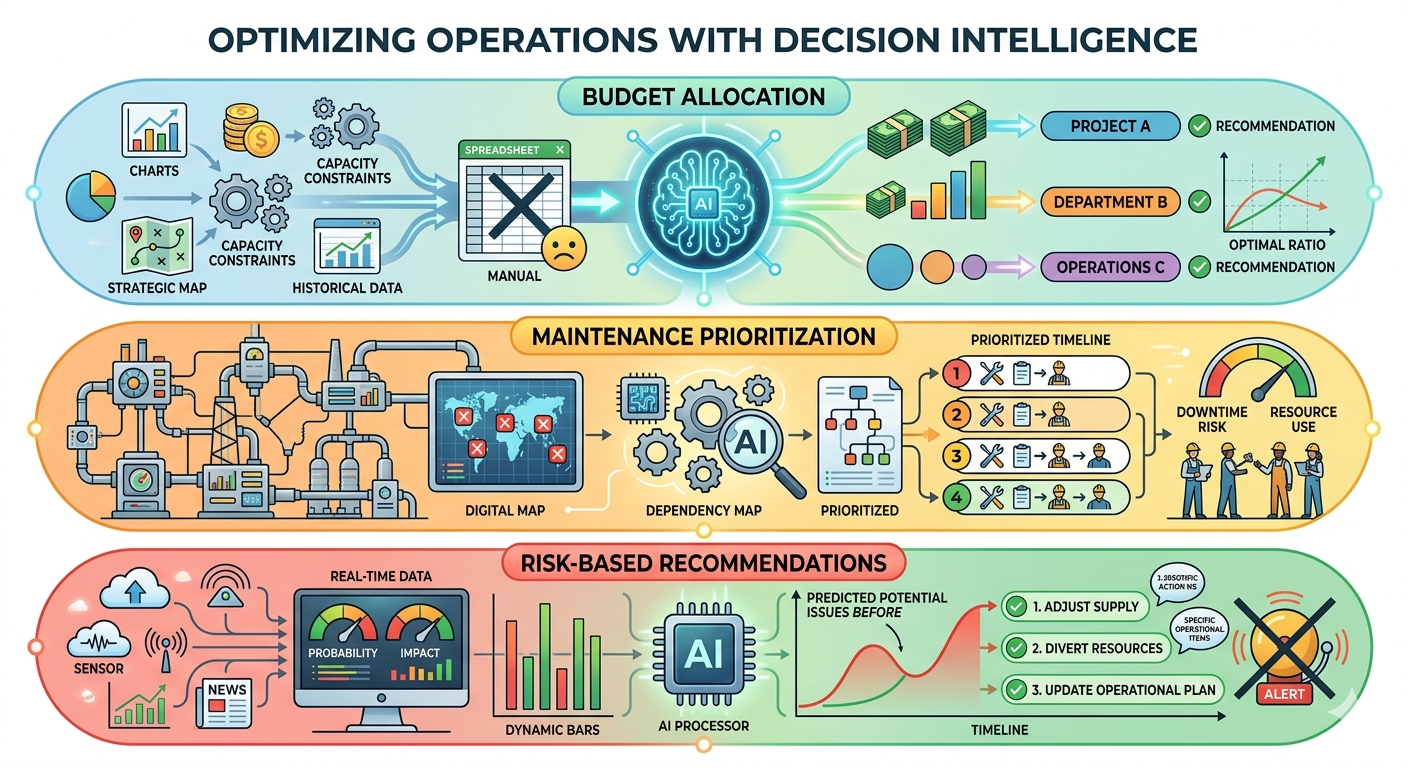
Consider a real example from asset-heavy infrastructure operations: given a fixed budget, a decision support system can evaluate every asset in the network — cross-referencing health scores, remaining lifespan estimates, failure risk, and repair costs — and return a ranked recommendation. Not just "this asset needs attention," but a fully reasoned comparison: full replacement delivers a reliability uplift from 42% to 95% and extends operational life by 25 years; partial repair extends life by roughly 2 years at a fraction of the cost. Here's the recommended option, here's the alternative, and here's why. That level of specificity, produced in seconds, changes how budget conversations happen.
2. Maintenance Prioritization
In asset-heavy environments, the cost of unplanned downtime dwarfs the cost of preventive action — but the challenge has always been which assets to prioritize, when, and with what resources. What makes this genuinely hard is that the relevant signals rarely live in one place. Thermal imaging flags a hotspot. Gas analysis detects an anomaly. Vibration data shows an emerging pattern. Maintenance logs record a repair from eight months ago. No single data stream tells the full story.
AI systems capable of reasoning across these multiple data types — structured sensor readings, unstructured image analysis, historical documents — can synthesize a unified health index per asset and translate it directly into prioritized work orders. The recommendation doesn't sit in a report; it flows into the maintenance workflow, with priority flagged and justification attached.
3. Risk-Based Recommendations
Real-time risk management requires continuously updating your understanding of probability and impact as conditions change. Decision support systems that are grounded in live operational data can surface risk-based recommendations before thresholds are breached — not as alerts to investigate, but as specific, actionable guidance on what to do about them. And critically, when operators ask why — which data sources drove this recommendation, which relationships in the system were traversed to reach this conclusion — the system can show its reasoning path in full. Trust in AI-driven decisions is built not just through accuracy, but through transparency.
The Architecture Behind It: Why Context Is Everything
A critical insight from organizations building these systems at scale is that AI recommendations are only as good as the contextual model underneath them.
The technical term is an ontology — a structured, connected map of the "nouns" of your business. Not just raw data tables, but a navigable representation of how your assets relate to each other: which equipment belongs to which facility, how sensor readings link to maintenance history, how failure events connect to service records. When visualized, this becomes an interactive graph operators can explore — zooming into a transformer, pulling up its associated inspections, gas analysis results, and lifespan projections in a single view. When AI agents reason over this kind of connected model, their outputs are grounded in actual operational reality rather than statistical patterns in siloed datasets.
This is the difference between AI that gives you generic analysis and AI that tells you specifically: the nearest available distribution center has inventory and is within range — these are the seventeen orders you need to reassign, and here's the recommended priority sequence.
The other essential design principle: chain of thought transparency. For AI to be trusted in operational decisions, operators need to see how it reached its conclusions — not just the recommendation, but the full reasoning path: which data sources were consulted, which relationships in the ontology were traversed, which trade-offs were weighed. This enables human review, course correction, and continuous improvement as feedback from real decisions gets incorporated back into the system. The AI recommends; the operator understands, adjusts if needed, and approves.
What This Means for D.Hub 2.0
This is precisely the direction D.Hub 2.0 is built toward.
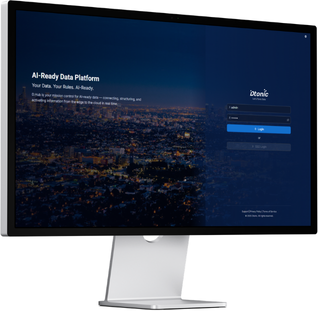
D.Hub 2.0 isn't designed to give you more dashboards. It's designed to give you better decisions. The platform is built around the same core principles described throughout this post: a connected operational data model — the ontology — that reflects how your assets, processes, and people actually relate to one another; AI agents that reason across that model when conditions change; and decision interfaces that keep humans in control while dramatically compressing the time from signal to action.
In practice, that means an operator can ask D.Hub 2.0 a question like "given our current budget, which assets should we prioritize for replacement this quarter?" — and receive not a dashboard to interpret, but a reasoned answer with options, trade-offs, and a recommendation. It means maintenance teams get work orders generated from AI-synthesized health assessments, not manually compiled reports. It means when something unexpected happens — a supply disruption, an equipment anomaly, a risk threshold crossed — the system doesn't just alert you. It tells you what to do about it, shows you why, and gives you the controls to act.
Whether the use case is infrastructure asset management, supply chain resilience, or operational risk response, the architecture is the same: clean, connected data as the foundation — multi-modal AI reasoning across that data — and decision tooling built for operators, not analysts.
The organizations that will operate most effectively in the years ahead won't be the ones with the most data or the most dashboards. They'll be the ones that have closed the Last Mile: turning information into action with speed, confidence, and accountability.
That's what decision intelligence is. And that's what we're building with D.Hub 2.0.