
Five industries that will be redefined by the Data OS & what it means for everyone else
Every major infrastructure shift follows the same pattern. A new foundational layer appears — electricity, the railroad, the internet — and most businesses treat it as just another tool. Then a smaller group figures out what's actually happening. This isn't a tool. It's a new foundation. And whoever builds on it first sets the terms for everyone who comes after.
We are in that moment now with the Data OS.
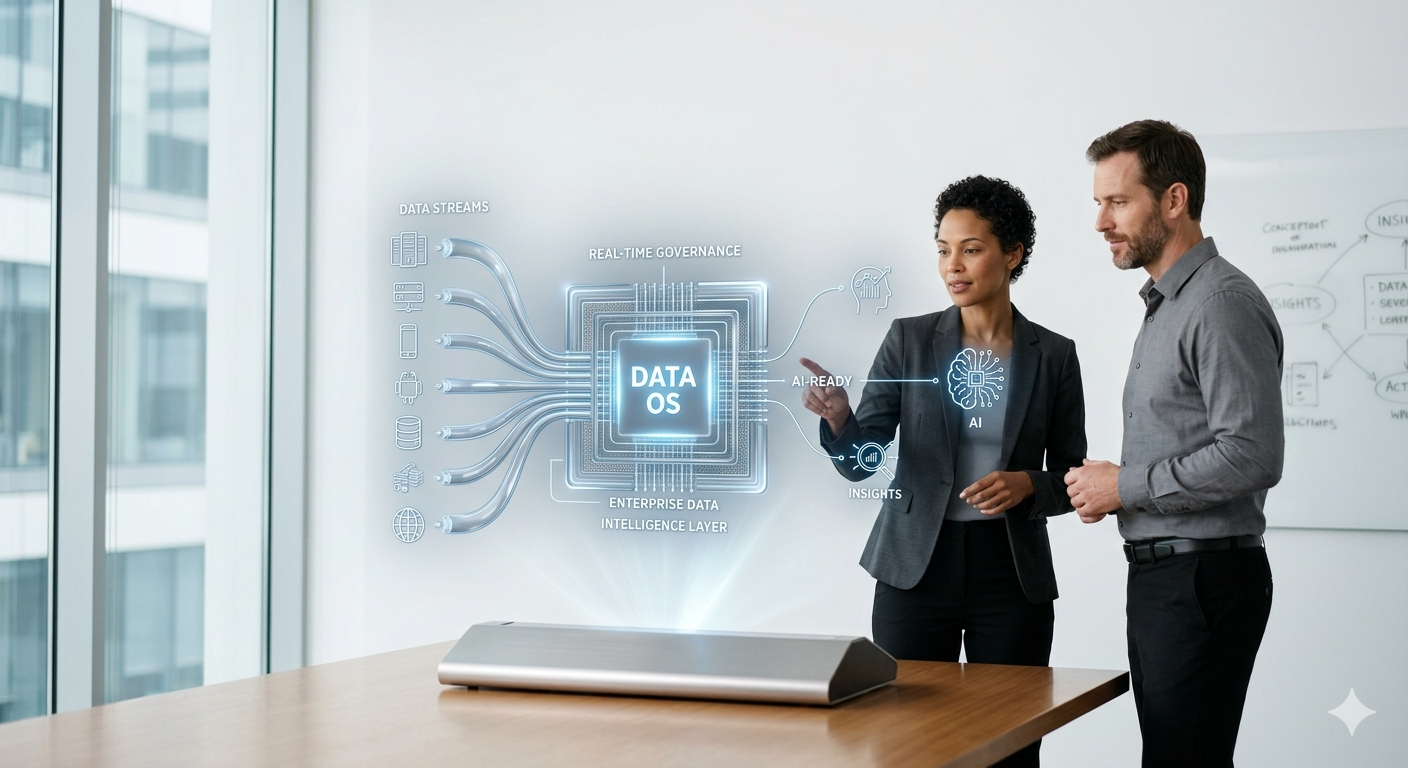
Not another analytics platform. Not a better dashboard. A genuine operating system for enterprise data — one that unifies every data stream a business generates, governs it in real time, and makes it AI-ready at the moment of need. Think of it the way you think of the OS on your laptop: it doesn't store your files or run your apps — it's the intelligence layer underneath everything that makes them work together. A Data OS does the same thing for your enterprise. It turns raw data into something intelligence can act on.
This is why we call D.Hub an AI Data Platform and a Data OS in the same breath. The "AI Data Platform" describes what it's built from. The "Data OS" describes what it does — and what it replaces. Not one tool in your stack, but the fragmented stack itself.
It works in three layers. The first connects and unifies data from every source — ERP systems, IoT sensors, CRMs, data lakes, external feeds — into a shared semantic foundation where a "customer," a "supplier," or a "plant" means the same thing across the entire organization. The second overlays intelligence onto that foundation: models, machine learning, forecasting, simulation — all running against live, governed data, not stale snapshots. The third surfaces all of that to the people who actually run the business, through operational applications they use every day. Most enterprise software does one of these three things. A Data OS does all three, on the same foundation, at the same time.
The difference isn't incremental. It's architectural. And five industries are already finding out what that means.
Their early movers are pulling ahead in ways that won't be easy to reverse. The forces driving it — real-time decision-making, AI at scale, regulatory pressure, customer expectation — aren't sector-specific. They're coming for every data-generating business on the planet.
Here's what it looks like in practice. And what it means for everyone else.
1. Healthcare: from reactive treatment to predictive care

Healthcare generates more data than almost any other industry. Every visit, every lab result, every scan, every wearable signal, every claim — it all exists, in theory, to tell clinicians exactly what a patient needs before something goes wrong.
In practice, almost none of it connects. EHRs from different systems don't talk. Wearable data lives in consumer apps that never reach the clinical record. Claims arrive weeks late. Genomics sit in a completely separate silo. The result is brutal: one of the most data-rich industries in the world routinely makes life-and-death decisions on incomplete, stale, fragmented information.
A unified patient data layer changes this at the foundation. When clinical records, real-time device signals, behavioral data, and population benchmarks all flow into a single governed environment, risk stratification stops being a quarterly exercise and becomes continuous. Sepsis models can flag deterioration hours before conventional indicators would. A care team can pull a patient's full longitudinal history in seconds rather than hunting across six systems.
But visibility alone isn't the point. A mature Data OS doesn't just surface a risk score — it presents care teams with pre-configured, auditable response workflows: escalation paths, treatment protocols, referral actions, each carrying the right permissions and documentation trail. The goal isn't a better dashboard. It's a system where insight and action are the same step.
Security works differently here too. In a true Data OS, access permissions are set at the source and travel automatically through every derived dataset and every application. A clinician who shouldn't see psychiatric records won't — regardless of which screen they're on. In healthcare, security that travels with the data isn't a technical nicety. It's a prerequisite.
Health systems on unified platforms are already seeing measurable reductions in readmission rates, faster diagnosis cycles, and earlier intervention for high-risk patients. That gap is only going to widen. Providers that can't unify their data won't be able to meet the outcomes requirements of value-based care contracts. And they won't be able to compete with digital-first entrants who are building on unified foundations from day one — and going after the same patients.
2. Financial services: from static risk models to living credit intelligence

At its core, financial services is a decision business. Lend or don't. Insure or don't. Flag or clear. For decades, those decisions have run on point-in-time snapshots — a credit score from this morning, a bank statement from last month, a fraud model trained on last quarter's patterns.
The world moves faster than that now. Fraud tactics evolve in hours. Credit risk can shift in days. And yet most financial institutions are still making decisions on infrastructure built for a world where data moved slowly, arrived in batches, and sat still long enough to be queried.
A Data OS changes this fundamentally. A unified data layer streams signals continuously — transaction patterns, behavioral anomalies, external feeds, network-level fraud indicators — and runs models against live data, not archived data. The difference in outcome isn't incremental. It's categorical.
There's another piece that doesn't get talked about enough: how a Data OS treats the models themselves. Instead of deploying one fraud model and hoping it holds, leading institutions now manage model portfolios — testing dozens of approaches against the same objective, comparing real-world performance, and promoting winners through governed approval workflows. Models, like data, get versioned, reviewed, and audited. The institution always knows which model made which decision, and why. That's rapidly becoming a regulatory expectation, not just good practice.
Fintechs on this foundation are approving creditworthy borrowers that legacy models decline — because those models can't read thin or non-traditional credit files. They're catching fraud in milliseconds, before a transaction clears. They're pricing financial products against actual real-time risk, not demographic proxies.
Traditional institutions have something challengers don't: the relationships, the capital, the regulatory standing. But what many lack is the data infrastructure to compete on intelligence. That gap is closeable. The institutions that close it will find their existing advantages compounding. Those that don't will find them eroding — faster than they expect.
3. Retail and commerce: from campaign marketing to individual-level intelligence

Retail has always been a data business. Loyalty programs, POS systems, e-commerce platforms, ad channels — decades of customer signals. The problem is none of those channels were ever designed to talk to each other.
So you get the dysfunction everyone knows: a customer browses online, buys in-store, gets an email the next day promoting what they just bought, then a retargeted ad the day after that. The retailer has everything it needs to know this customer already converted. It just can't connect the dots in real time — because the loyalty system, the e-commerce platform, the POS, and the ad platform all live in separate silos, speaking separate languages, updating on separate schedules.
A Data OS doesn't solve this by integrating those systems more cleverly. It replaces the fragmented data layer underneath them with a single unified environment. Every signal a customer generates, across every touchpoint, flows into one governed layer where it immediately carries shared meaning. The loyalty event and the in-store purchase aren't two separate records. They're one customer journey.
This is where the semantic foundation really matters. A warehouse stores tables. A Data OS builds a shared representation of your business objects — customers, products, transactions, campaigns — their relationships and the rules governing them. Every team, every model, every application works from the same understanding of reality. Personalization becomes genuinely individual, not cohort-level. Inventory decisions reflect actual demand, not historical averages.
Retailers on unified platforms see higher basket sizes, lower return rates, and better inventory efficiency — because they're responding to actual people, not fictional averages.
And the compounding effect is real. Personalization drives loyalty. Loyalty drives data. More data drives better personalization. Retailers that can't enter that loop face a structural disadvantage that grows worse over time, not better.
4. Manufacturing: from planned maintenance to zero-downtime operations
Manufacturing has digitized aggressively over the past decade. Sensors everywhere. Continuous telemetry. Supply chain systems logging every movement of every part. The data infrastructure of a modern plant would have seemed extraordinary twenty years ago.
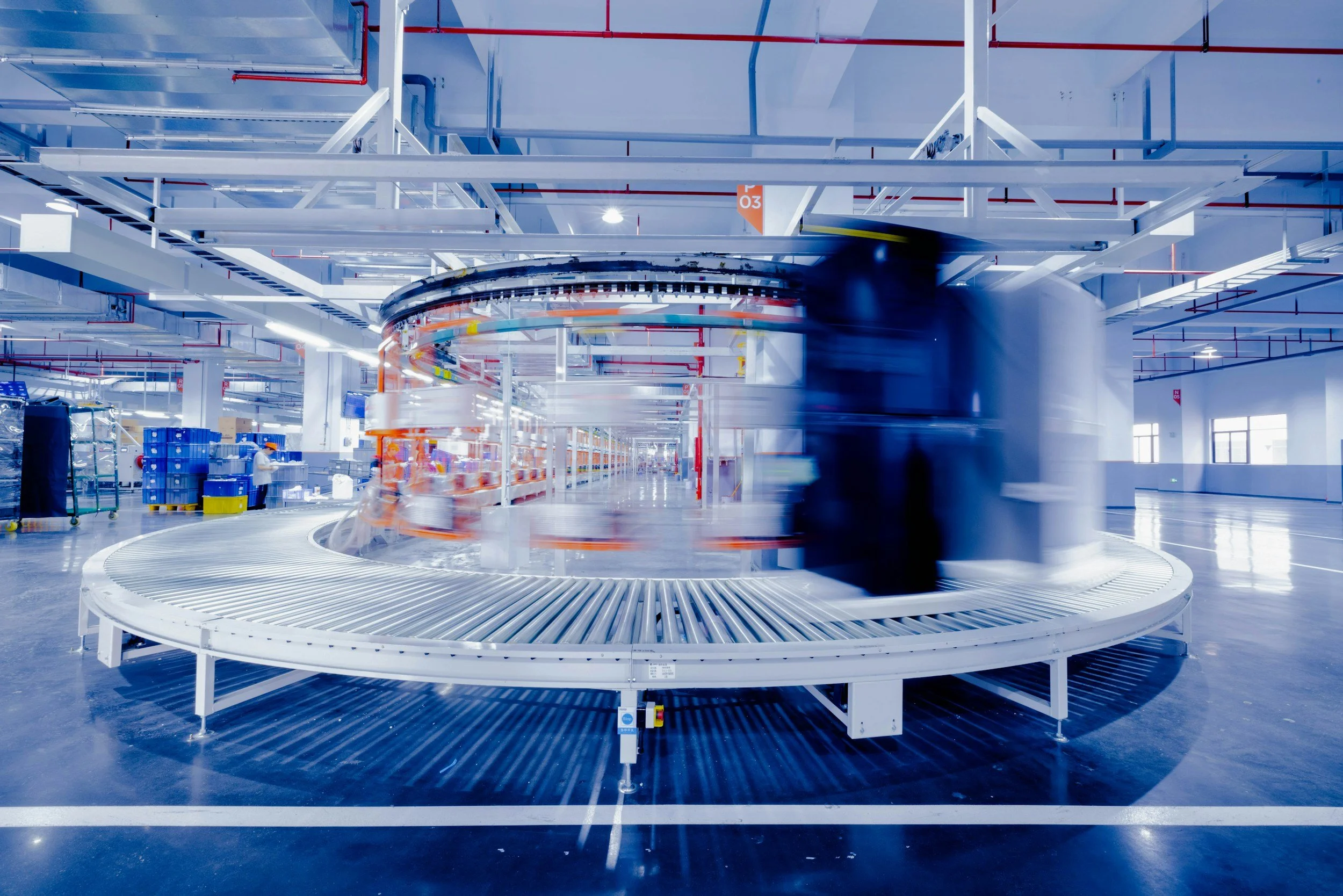
And yet, for most manufacturers, that data still doesn't connect in real time. Operational technology — the systems running the factory floor — and information technology — the systems running the business — remain largely separate worlds. Sensor data gets stored but rarely acted on before something breaks. Supply chain signals arrive too late. Quality problems surface in inspection rather than in production.
A Data OS bridges this. By unifying OT and IT data — sensor readings alongside procurement records, equipment telemetry alongside demand signals — manufacturers get something they've never had before: a live model of their entire operation.
Predictive maintenance becomes actually predictive. When a machine's vibration signature starts deviating, a model flags it and schedules maintenance before failure — not after. Yield optimization runs continuously, adjusting parameters in real time rather than after the shift review.
The most forward-looking manufacturers go further and use their Data OS to simulate operations, not just monitor them. Running scenario models on a live replica of operational data, they can stress-test supply chains before disruptions hit. What happens if a key supplier goes offline? How does capacity shift if a major customer's demand doubles? These used to be weeks of analyst work. On a unified data foundation with integrated modeling, they're real-time scenarios operations teams can run and re-run as conditions change.
There's also a governance piece specific to manufacturing that matters. When a data pipeline needs to change — a new sensor added, a transformation rule updated — a mature Data OS lets that change be tested in a sandboxed branch before it touches anything downstream. Data changes get the same discipline as code changes: reviewed, approved, reversible. For manufacturers where a bad transformation can cascade into production errors, that's not a minor feature.
The results are measurable: substantial reductions in unplanned downtime and real improvements in scrap rates and first-pass yield. And as customers in automotive, aerospace, and consumer goods increasingly demand supply chain transparency and data traceability, manufacturers that can't demonstrate a unified data foundation will feel that pressure in procurement conversations — soon.
5. Logistics and supply chain: from static routing to adaptive networks
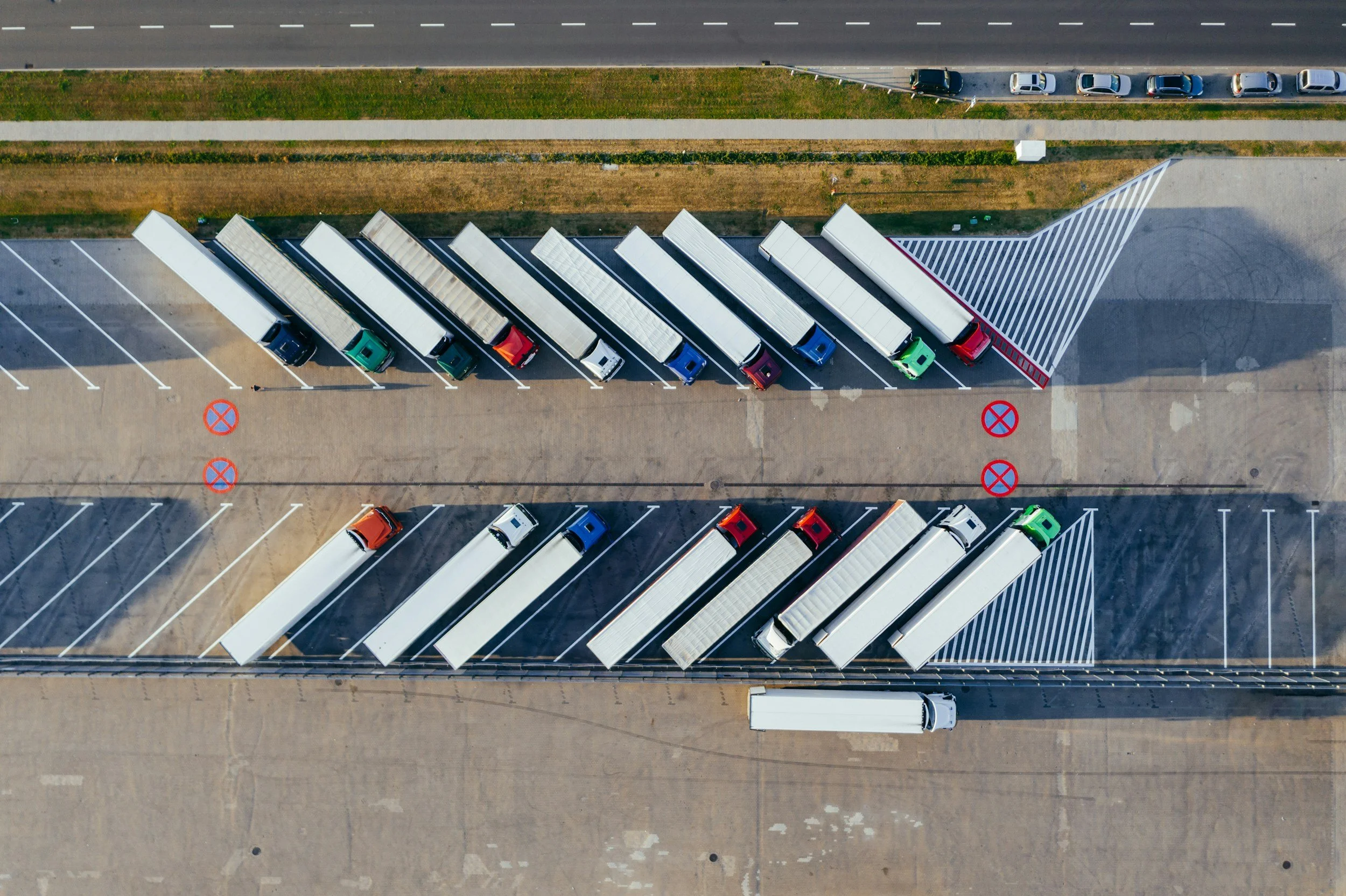
The pandemic made visible something supply chain professionals already knew: global logistics networks are fragile in ways that point-in-time planning can't protect against. Routes built for normal conditions fail under disruption. Inventory positioned for expected demand ends up in the wrong place when demand shifts. Carrier commitments made on weekly data are outdated before the ink dries.
The reason is structural. Most logistics operators make decisions on yesterday's data — yesterday's traffic, weather, carrier capacity, inventory levels. In a stable world, that's fine. In a volatile one, it's a liability.
A Data OS changes the temporal foundation of how logistics decisions get made. When a unified layer ingests real-time signals — weather systems, port congestion, carrier GPS, demand fluctuations, customs clearance — routing and inventory can respond to the world as it is, not as it was. Exception management stops being reactive firefighting. A storm developing over a major hub triggers rerouting hours before delays compound, not after.
The most advanced operations take this further by connecting the full value chain into a single view. Upstream supplier status, mid-chain carrier performance, downstream customer demand — all in the same environment. A disruption at one node is understood in the context of every node it affects. When you can see the whole chain at once, you stop managing exceptions one at a time and start managing the system.
And when intervention is needed, the action matters as much as the insight. A Data OS doesn't just tell an operator a shipment is at risk — it surfaces the governed response options: reroute to an alternative carrier, expedite from a secondary warehouse, notify the customer with a revised ETA. Each action carries approvals, audit trails, and write-back routines that sync the decision back to source systems. The goal isn't visibility. It's the shortest possible path from insight to correct action.
Logistics operators on real-time platforms are compressing delivery windows, absorbing supply shocks that stall competitors, and offering adaptive SLA commitments that fixed-routing operators can't match. For shippers, that capability difference is increasingly visible — and increasingly decisive when contracts are up.
The market for logistics services is being repriced around data capability. Carriers and 3PLs that can't demonstrate real-time visibility will find their pricing power shrinking as volume flows to operators who can. The infrastructure investment to compete on data is no longer optional. It's the entry cost for staying in the conversation.
What it means for everyone else
If your industry isn't on this list, don't take comfort in that.
The forces driving these transformations — real-time decisions, rising AI expectations, personalization demands, data traceability requirements — aren't sector-specific. They're the direction of a data-saturated economy. The five industries above are simply where the cost of fragmentation is most visibly expensive right now, and where unified data foundations are most immediately measurable.
Others are close behind. Energy and utilities are navigating real-time grid optimization with fragmented sensor infrastructure. Media and entertainment are losing ad revenue to platforms with better audience data. Professional services firms are sitting on decades of proprietary client data that their infrastructure can't activate. Education is collecting learning data it can't use to improve outcomes.
Three signals that your industry is entering this shift. First: real-time decision-making is becoming a competitive differentiator and your infrastructure makes it slow or expensive. Second: you've approved AI initiatives and discovered the data foundation they need doesn't exist yet — because AI is only as good as the data layer it runs on, and a fragmented layer produces fragile AI. Third: a competitor — usually a newer, digital-first entrant — is making decisions faster or more accurately than you, and you can't fully explain why.
These aren't technology problems. They're infrastructure problems. And infrastructure problems don't get cheaper to solve by waiting.
The question worth sitting with
Every infrastructure shift produces the same two outcomes. Companies that understand the new foundation early build on it, and their advantages compound. Companies that treat it as optional bolt tools onto existing architecture and find themselves perpetually behind — not from lack of ambition, but because they're building on ground that was never designed to support what they're trying to do.
The Data OS is that shift. It's not a single product, and it's not a project with a finish line. It's a fundamental change in how enterprises relate to their data — from a historical record to be queried, to a living operating environment to be acted on. From a passive archive to an active system that unifies, governs, models, and acts — continuously, across the entire organization, in real time.
The question for every business leader reading this isn't whether the Data OS will reshape your industry. It will. The question is whether you'll be the one doing the reshaping — or the one being reshaped.
If this article raised questions about your own data infrastructure, that instinct is worth following. We help leadership teams move from fragmented data environments to a unified foundation — without the noise. Contact us via email.